Prompting Hacks Every eCommerce Leader Needs in 2026
19 June 2026 AI
If you are feeling behind on AI, you’re not alone. Most Australian eCommerce leaders are still trying to nail down how to incorporate LLMs into their marketing flows and using AI technologies to boost productivity. Not always, but often, the problem doesn’t lie with the tool but with your prompt. AI is only as smart as the instructions you give it. And if you want it to support your SEO and AEO strategy in 2026, you need to brief it like you would a high-performing team member.
If you want to get the most out of generative AI, you must think with ‘TCREI’ in-mind
Google’s AI experts summarise prompting with a simple framework: TCREI: Task, Context, References, Evaluate, Iterate.
Think of TCREI as your 5 easy steps that you can follow to write great prompts. It all comes down to your understanding of inputs and outputs.
What are you hoping to get from the tool? That’s the output. What kind of prompt is going to help you get it? That’s the input. While ‘TCREI’ comes from leading Google AI experts, it can be applied to provide you with clear and specific directions to any gen AI tool.
You might want to save it in your phone or write it on a sticky note for your desk. When you’re prompting an AI tool, you need to be clear and specific about the task. If you’re vague with your instructions, you’re likely to get bad results.
Did you know? 70% of marketers now use generative AI in some capacity. And 50% or more of AI output usefulness can be lost due to poor prompts, often resulting in hallucinations, fluff, or generic advice.
The Key: Better Inputs = Better Outputs
Using the prompting framework
Just like when you design text-based prompts, you’ll still rely on the prompting framework for multimodal prompts. However, you might need to adjust the framework based on the modalities you’re using in your prompt. Here are the five steps of the prompting framework.
- Task: Along with being specific about a persona and format, be specific about how you want different modalities to be used and why you’re including them in the task.
- Context: Just like in a text-based prompt, you’ll need to add context so the gen AI tool knows exactly what you want it to do. Consider which modalities you’re using in your prompt when providing context, and if any specific constraints or considerations are important to include.
- References: Share written, visual, or audio references to help gen AI tools understand the type of output you’re trying to create. Not every tool supports every sort of reference, so make sure you’re using a gen AI tool that supports the references you want to give it.
- Evaluate: Run the prompt as usual, but take extra care to evaluate how the output looks or reads. Since you’re using different modalities, that might involve a more detailed review of the output rather than simply evaluating a text response.
- Iterate: If the output is not meeting your needs, try one of the four iteration methods: you can revisit the prompting framework, break the prompt down into shorter tasks, introduce constraints, or tweak your phrasing or switch to an analogous task to help trigger a different, potentially better, response.
Don’t forget reference materials! One of the most underused prompting hacks is references. If you show AI what good quality work looks like, the output improves dramatically.
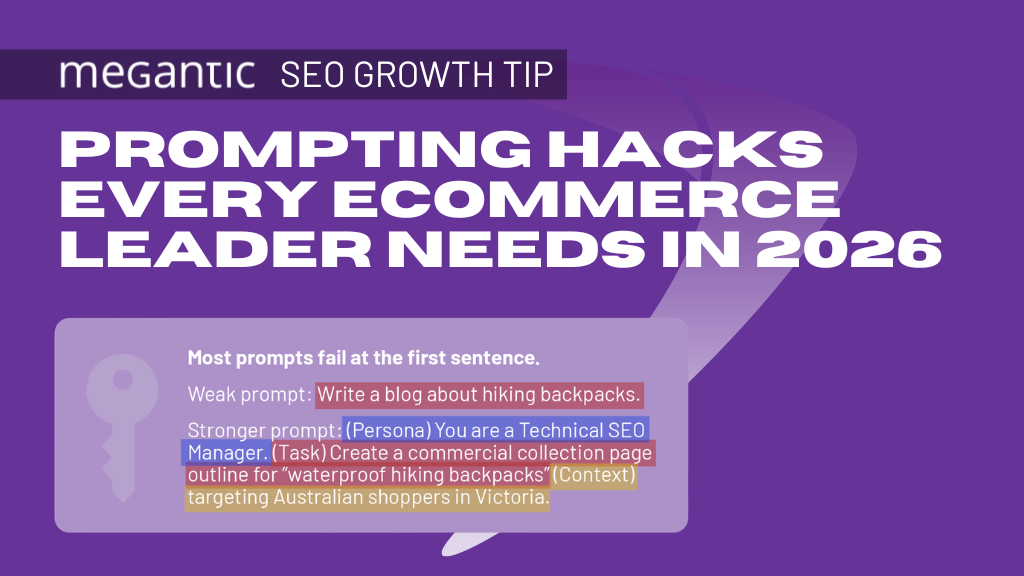
Most prompts fail at the first sentence.
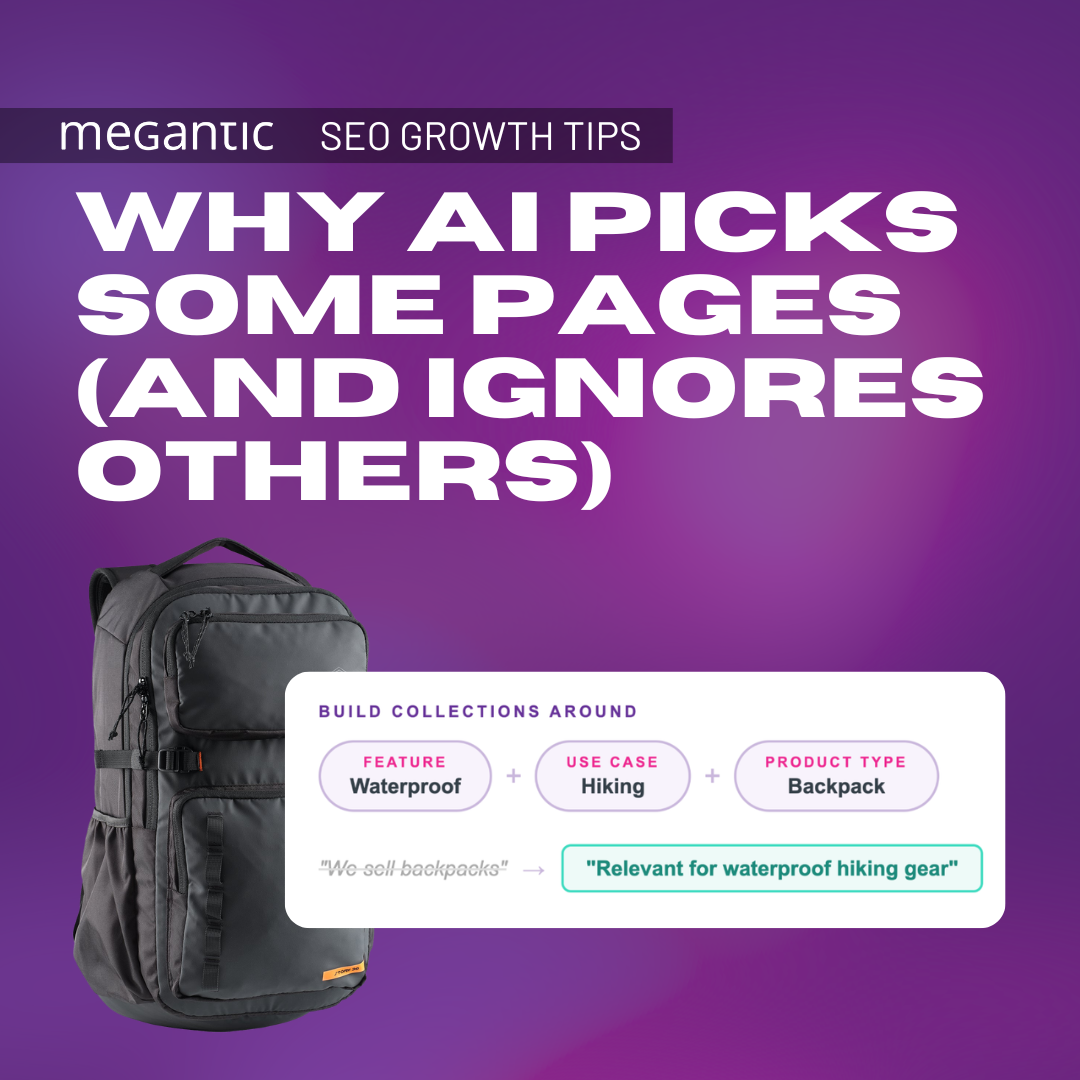
Weak prompt: Write a blog about hiking backpacks.
Stronger prompt: (Persona) You are a Technical SEO Manager. (Task) Create a commercial collection page outline for “waterproof hiking backpacks” (Context) targeting Australian shoppers in Victoria.
See the difference? When you’re vague, you’ll get generic output.
Prompting Techniques and multimodal prompting?
Modalities are different types of formats, like text, image, or audio, that can be used to instruct a generative AI tool. Simply put, multimodal prompting is when you use multiple modalities in the same prompt.
Multimodal prompting lets you do things, for example: translate images into detailed text descriptions for visually impaired users or extract text from a flat image. Perhaps, you’ve already experimented with LLMs with these prompts.
Benefits and considerations
Think about it like this: the world is multimodal. When you’re giving a presentation at work, you’re probably using text, images, and your own voice to help your audience understand your point. Multimodal prompting works in the same way. It reflects how you experience the world by building connections between text, images, audio, and other modalities, helping you provide clearer instructions to a Gen AI tool.
Including multiple modalities isn’t a one-size-fits-all solution, but it can improve your prompts. For instance, if you ask a gen AI tool to write a poem about a sunset and include a photo of one in your input, the gen AI tool can use the photo to describe specific colours and details. The result is a much more vivid poem. While multimodal prompting is versatile, it has some limitations. Gen AI tools sometimes struggle with abstract ideas, handling complex combinations of modalities, and occasionally, just plain old common sense.
You’re the artist, and the gen AI tool is your paintbrush
Multimodal prompting works best when you need to transfer information from one medium to another. It’s a powerful way to transform information into different formats and unlock new creative possibilities. If you want AI to recommend your products, cite your brand, and trust your information, you need to structure your inputs with intention.
Trigger specific LLM data
LLM responses rely on a combination of pre-trained data and fresh data fetching (accessing the web). So, if you want to trigger the LLM to look for up-to-date data specifically, you need to communicate that via freshness signals. Freshness signals can be triggered with words such as: “Today”, “Latest”, “Current”, “[year]”, “News” and “Price”. For example, a prompt that uses a freshness signal would be: “What are the best outdoor running shoes for men in 2026?”
Effectively, you need to signal to the LLM that the information you are seeking is either dynamic or time-specific/sensitive, meaning it can’t rely purely on its pretrained data. Typically, the LLM will try to understand the intent of your query, and as part of this process, it tries to classify and label the type of information that is required. For example, if a user searched up “what are water molecules made of”, the LLM would reason that this information is timeless, meaning that its pretrained data is sufficient.
However, if you searched for “what are the best outdoor running shoes in 2026”, you would prompt the LLM to find up-to-date, relevant information. The internal reasoning of the model can be really broken down to: IF query contains freshness signals OR domain is volatile, THEN use live retrieval. ELSE answer from model knowledge.
So, if you’re doing research and want the most up-to-date information, or if you’re a Marketing Manager researching your brand’s visibility (or maybe doing a cheeky stalk of your competitors), make sure you use specific terminology, language that is time and location dependent, and overall provide as much depth as possible.
Beyond Prompting: Mastering AEO for eCommerce in 2026
Prompting isn’t just about getting better outputs from AI. For eCommerce brands, it’s about understanding how customers are increasingly discovering products through AI-powered search experiences. As search behaviour evolves, consumers are moving beyond traditional keyword searches and asking conversational questions through tools like ChatGPT, Gemini, Perplexity, and Google’s AI Overviews. The brands that appear in these responses are typically those with clear, authoritative, and well-structured content.
The same principles that make a great prompt effective also make your website easier for AI systems to understand. Clear context, strong references, structured information, and specificity all help large language models interpret and surface your content with confidence. Happy prompting, and if you enjoyed reading this blog, it’s a chapter out of our new whitepaper with Shopify, ‘ 2026 Search Landscape: How AEO Is Redefining Shopping for eCommerce Brands’. Download free today.