Search Trends: What 18 Months of AI Traffic on 150+ business Data Reveals
20 July 2026 Blog Posts
It’s an interesting time for Aussie retailers with consumers increasingly turning to AI-powered platforms like ChatGPT, Gemini, Perplexity and Claude to find information, compare products and make purchasing decisions. Marketing teams want to be across the latest search trends, and at the centre of those conversations is AEO trends.
Answer Engine Optimisation (AEO) has stopped being a future consideration. It is already showing up in our client reports. And we’ve been asking questions for the last 18 months, trying to analyse just how AI search is impacting traffic across our client portfolio. While the headlines often suggest AI is replacing traditional search, the reality is more nuanced.
According to Forbes data, “AI market size is expected to reach $1,339 billion by 2030”
We operate across three continents with hundreds of clients, running on every major platform from Shopify, Magento, WooCommerce, Bigcommerce and more. Which means we are uniquely placed to investigate these search trends. What gives us is a reasonably wide window into how traffic is actually shifting, rather than how it’s being talked about. So we pulled the session data across our client base and compared the last six and twelve months against the periods before them. If you don’t have the time to read this mini study, the biggest takeaway is that when we analysed 150+ eComm Megantic Clients’ AI traffic, AI sessions grew 47% in the last 12-months compared to the previous year.
The Reality of AI Traffic in 2026
We’ve seen huge volatility across the AI platform’s popularity in the past year and for the month of May 2026, we saw ChatGPT perform as the only AI platform to grow, reaching approx +60% growth in traffic referrals. While Claude continued its upward trajectory, building on the major spike seen in March and remaining one of the fastest-growing AI traffic sources.

One of the biggest misconceptions surrounding AI search is that Google is rapidly losing relevance… but our data tells a different story. Across our client portfolio, Google remains by far the largest source of organic acquisition. However, we are seeing a gradual shift in market share.
AI traffic has increased almost tenfold in just 18 months. Looking at the last 12 months compared with the previous 12-month period, AI traffic has grown by 47%. That’s significant growth by any standard; however, context matters. Even after this rapid increase, AI-driven sessions still represent less than 1% of total website traffic.
Why AI Traffic Matters Despite Being Small
Traffic trends often start small before becoming meaningful. Mobile traffic was once a fraction of desktop traffic. Social media referrals were once considered experimental. The same pattern is emerging with AI search. The growth rate is what makes AI traffic impossible to ignore. When we analyse referral data from platforms like ChatGPT and Perplexity, we consistently see strong intent from users who are further along the buying journey. These users are not simply browsing. They are researching products, comparing options and seeking recommendations.
As AI adoption continues to grow, brands that establish visibility now may gain a significant advantage later.
Moving beyond rankings
Answer engine optimisation is the practice of structuring content so that AI systems like ChatGPT, Perplexity, Gemini and Google’s AI Overviews can pull it out, trust it, and use it directly in the answer they generate. Traditional SEO is built around earning a ranking position and a click. AEO is built around earning the citation itself, the sentence the AI delivers and the source it credits for that sentence, often without the user clicking through.
The new gatekeeper, Large Language Models (LLMs) like Google Gemini, ChatGPT, and Meta’s open models, are becoming the decision layer of the internet. They don’t just surface pages. They interpret brands, compare products, cluster meaning, and generate answers in real time.
This is why the future of SEO is shifting from “optimising pages” to “optimising understanding”. This matters because AI search is not behaving like traditional search engines. Instead of retrieving ten blue links and letting the user decide, LLMs are increasingly deciding on the user’s behalf. They decide which products best match the query, which brand is most reliable, and which sources are trustworthy enough to reference. To stay visible in this new environment, marketers need more than surface-level trends.
What can you do today
You need to understand how AI actually reads your eCommerce site, how it interprets your brand, and why it chooses to include (or exclude) your products when answering a shopper’s question.
The new E-E-A-T is machine-based, not human-based In traditional SEO, E-E-A-T was a framework that shaped how content should look to quality raters and search engines. It helped SEOs understand why certain sites ranked, especially in competitive categories. In AEO, the same concept exists, but it has evolved. E-E-A-T is no longer just inferred through backlinks or content quality. It is increasingly modelled through AI interpretation, meaning the model forms an opinion about your brand through patterns across the web.
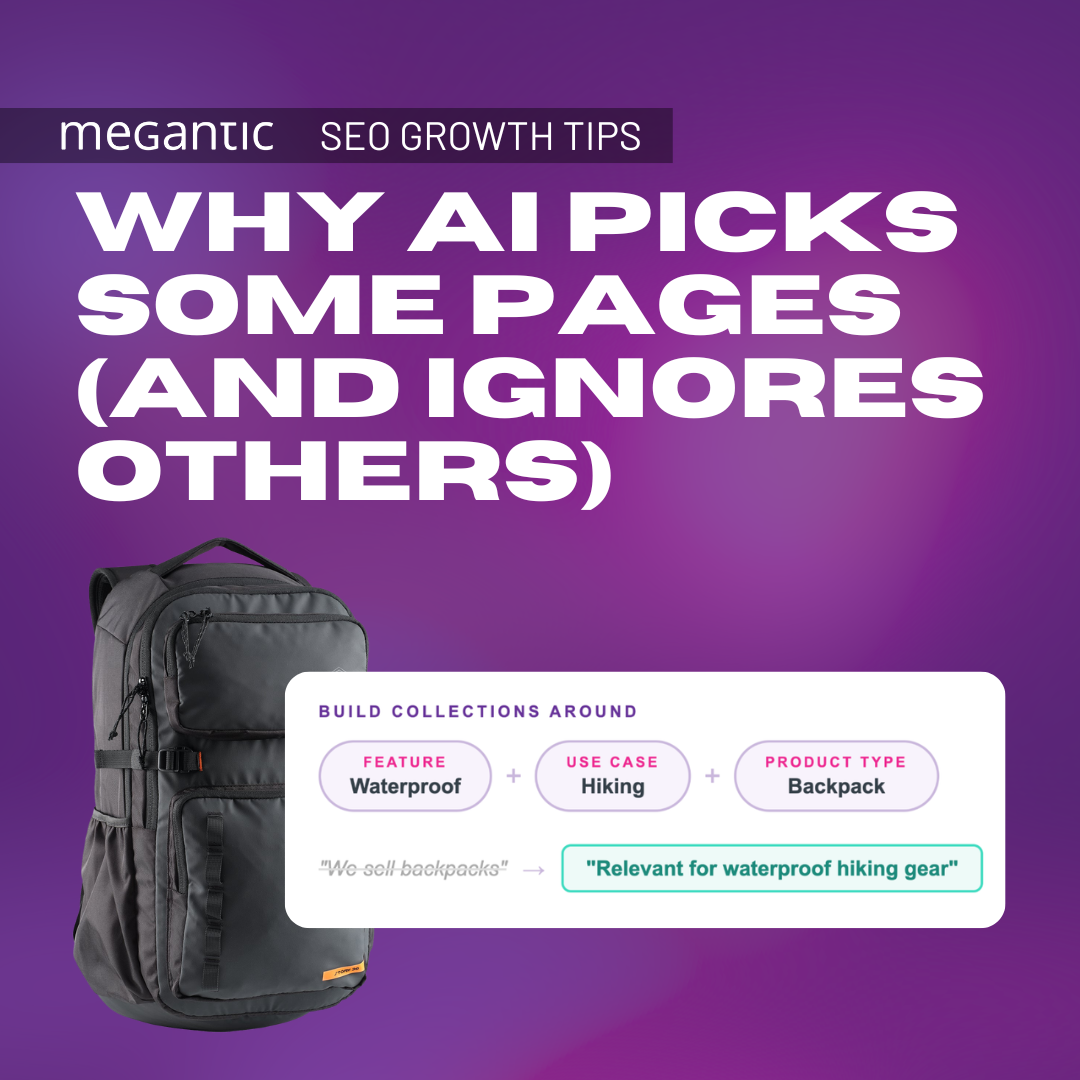
How LLMs actually read an eCommerce store This is why semantic SEO matters so much more than keyword density. The model is no longer scanning for “boots” in isolation. It is interpreting context. It understands the differences between boots that suit a corporate office, boots that suit hiking and boots that are weatherproof. The keywords may overlap, but the meaning does not. Next, the model builds entity relationships. It connects concepts like brand, material, product type, gender, style, use case, audience, price tier, and even seasonal relevance. This is one of the reasons consistent naming conventions matter so much.
LLMs form “memories” of brands based on repeated patterns across time. They learn what a brand is known for, how it positions itself, and where it typically belongs in a category landscape. Brands with weak external presence have weaker memory footprints. That makes it harder to surface as a recommendation. And to make the system even more complex, different models interpret sources differently.
Gemini may favour structured data and signals from Google’s ecosystem. ChatGPT may lean more heavily on broad web consensus and editorial sources. Meta models may behave differently depending on training data and conversational context. That means AI visibility isn’t a single channel. It’s a multi-surface ecosystem, and brands need to build authority in a way that transfers across multiple models.
The numbers, and why the scale matters as much as the growth
Across our full client base, comparing the last 12 months to the 12 months before that, Google’s share of total sessions dropped from an average of 53.68% to 45.04%, a decline of 16%. Over the same period, AI-driven sessions grew from an average share of 0.23% to 0.34%, growth of 47%. Both of those numbers are real, and they point in opposite directions for a reason: Google traffic is shrinking as a proportion of the pie, and AI traffic is growing fast, but it’s growing fast from an extremely small base.
Even after that growth, AI sessions still don’t make up even half a per cent of total traffic for the average store on our books. Anyone telling you to pull budget out of organic search and pour it into “AEO strategy” this year is solving for a problem that, in scale terms, doesn’t exist yet.


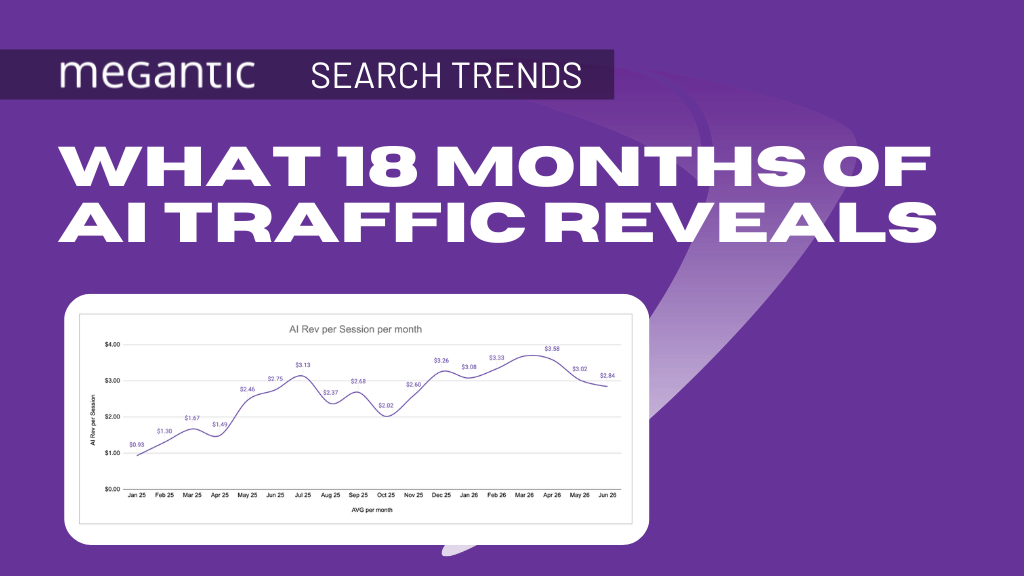
We see by looking at this graph that AI revenue per session has increased steadily over the last 18 months, rising from $0.93 in Jan 2025 to a peak of $3.58 in April 2026, before moderating slightly to $2.84 in June 2026.
Looking at the more recent six-month window against the six months before it, Google’s decline accelerated slightly to 18%, while AI session growth slowed to 4%. That’s worth sitting with for a second, because it cuts against the usual narrative. The relative growth rate of AI traffic isn’t accelerating in our data; it’s cooling, even as Google’s share keeps eroding.

We also looked at the single most recent month against the same month a year earlier, where Google sessions were down 16.89%, and AI sessions were up 119.70%. We’re flagging that last number rather than leading with it, because a single month is volatile by nature and a number like that says more about how thin the AI traffic base still is than about a sudden acceleration.
One pattern in the data argues against the idea that AI traffic is simply cannibalising what Google used to send. Across all industries we track, Google sessions declined by 16% over the last 12 months.
What this means for you as an eCommerce store
The future of search isn’t Google versus AI, but rather It’s Google and AI. For brands willing to adapt, Answer Engine Optimisation represents an opportunity to expand visibility, build authority and reach customers wherever they choose to search. At Megantic, we’re continuing to monitor these trends closely and help brands navigate the next evolution of search. The businesses that start preparing today will be in the strongest position tomorrow.
The first move is simple, and most teams haven’t done it yet: check your own GA4 channel data for AI referral traffic. It’s almost certainly already there, even if it’s a fraction of a per cent, and watching its trajectory over a few months tells you more than any industry report will. The second is to stop treating this as a separate budget line.
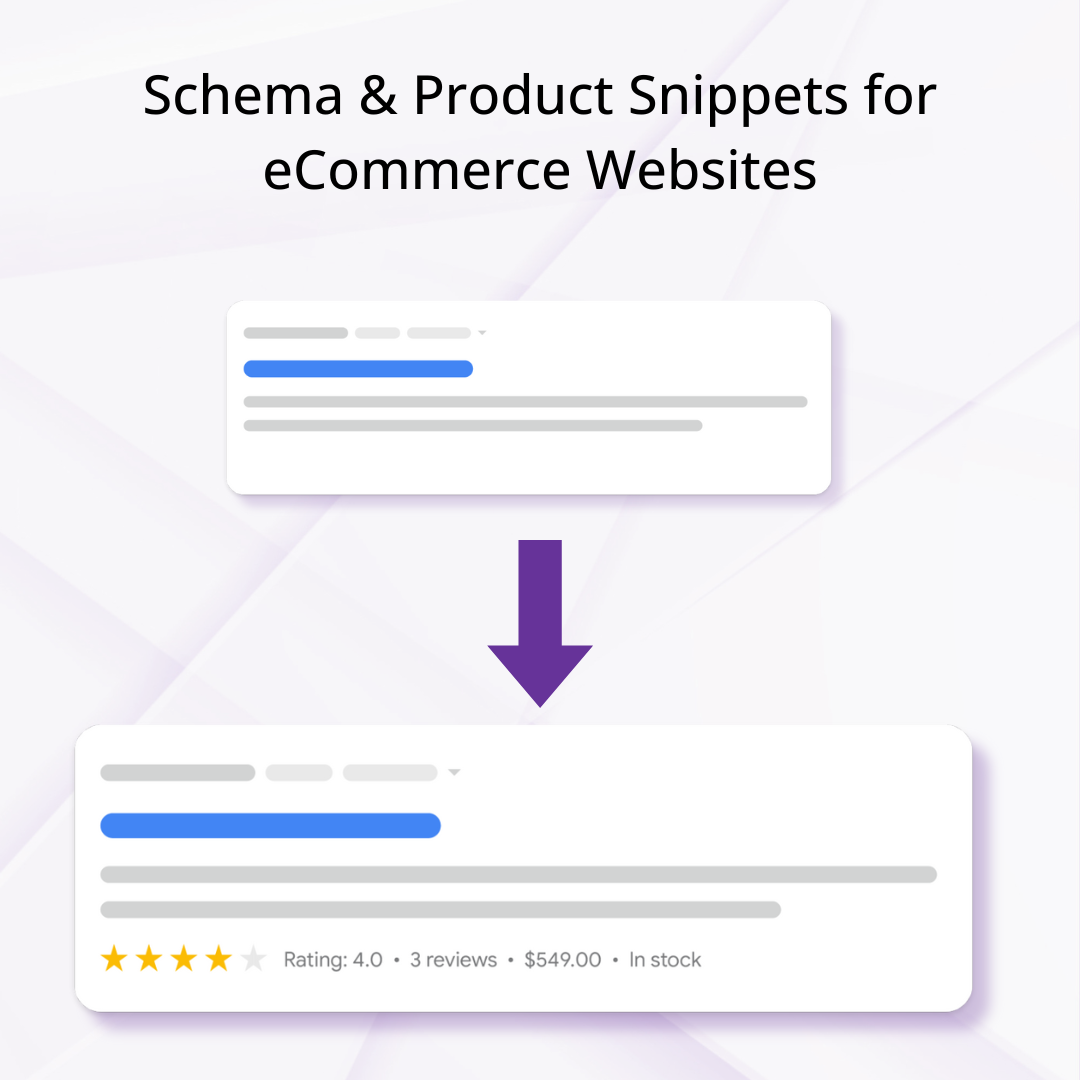
The technical and content work that earns AI citations, clear entity signals, content that states its answer early, FAQ and how to format structured data that matches what’s actually on the page is mostly an extension of strong SEO fundamentals rather than a parallel discipline. Clients who are already underinvested in technical SEO have a bigger problem than AEO, and fixing that foundation moves both numbers at once.
The third is to keep expectations honest. AI traffic is growing quickly, and it’s worth tracking and preparing for, but at well under half a per cent of average session share, it isn’t yet the channel that determines whether an eCommerce business hits its revenue targets this year. Google still is, even with its share declining. Anyone planning a 2026 strategy that quietly assumes otherwise is planning for a future that hasn’t arrived yet.
Answer Engine Optimisation (AEO) represents a critical opportunity for brands to expand visibility and build authority in this new era. Far from making SEO obsolete, AEO is an extension of it; the same foundations of technical excellence, topical authority, and high-quality content that drive traditional search rankings are precisely what AI systems require to cite your brand as a trusted source. For brands willing to adapt, the next evolution of search offers a powerful way to reach customers wherever they choose to find information.
The future of search isn’t Google versus AI, but rather Google and AI
For brands willing to adapt, Answer Engine Optimisation represents an opportunity to expand visibility, build authority and reach customers wherever they choose to search. At Megantic, we’re continuing to monitor these trends closely and help brands navigate the next evolution of search. The businesses that start preparing today will be in the strongest position tomorrow.
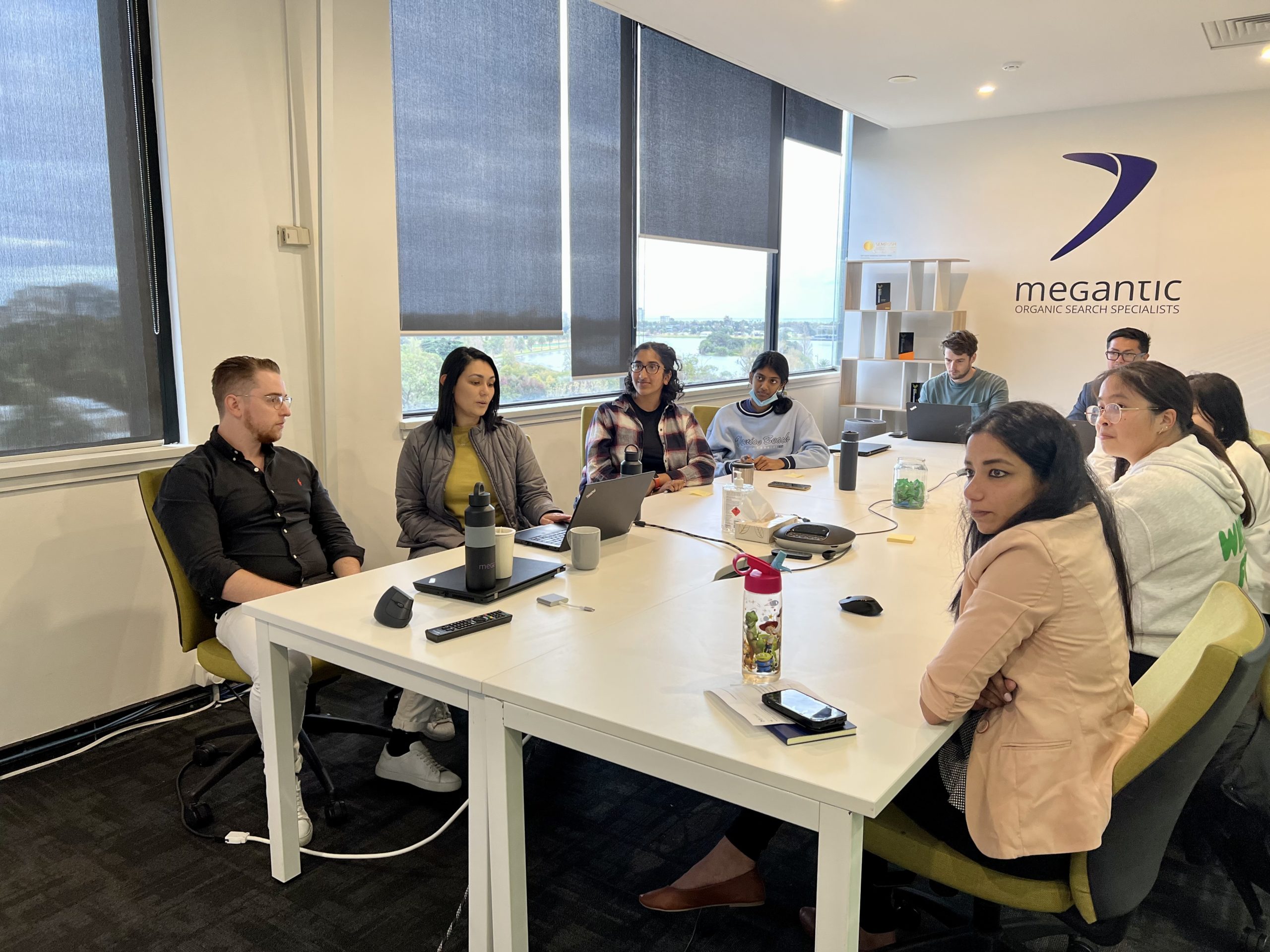
Why are we uniquely placed to dissect the traffic trends? As a specialist SEO & AEO eCommerce agency that has completed roughly 800 global projects and currently manages 250+ active clients, we align site visibility strategies to ensure brands remain authoritative sources in both AI-generated responses and conventional search results. If you want to see where you stack up against these benchmarks, or want help building the foundations that will get you chosen online, whether that be traditional or emerging search, get in touch with Megantic.